I met up with my wife who was already at one of the pre christmas moving street rosaries. Each night a large processio marches on a different route within the city reciting a rosary. Each person carries a candle, their faces bronzed and changing from the flickering tapers. Residents on the streets along which the rosary passes decorated their houses with blue and white cut paper banners.

This was the second of nine consecutive evening rosaries called a novenario. The christmas rosaries honor La Virgen de Los Dolores, the Virgin of Tenancingo.

La Virgen de Los Dolores Tenancingo in a mid 1800 era , like a collage- painting with a silver dagger positioned over the silver heart of Mary who sports a real silver halo,, and above the halo a solid gold crown. A patron is painted into the lower left hand corner. In early june 2018 there was a robbery. The story goes as follows: thieves hid within the basilica San Clemente coming out after all was locked up and stole the golden crown. It was considered a national treasure.
There are many more churches dedicated to Virgins than to Jesus. Jesus just may be God yet Mary as his mother, trancends his accomplishments and suffering. Her figure has been molded to fit each catholic culture. Her images are everywhere in the catholic world and even if all are slightly different we are capable of distilling the essence of motherhood from each and every one. I guess Mom is a more mysterious and more powerful character than her Son-Dad. First of all she is more acessible because she is not a diety. She is often seen cradling her son. If one casts aside the invented myth of a virgin birth, meant to elevate her to an incongrous and remote level of cleanliness, her figure returns to us,, emotionally closer,, and more well defined than her son. It is easy to see how the faithful appeal to this universal icon of motherhood to heal the soul and body.
In Mexico there are many statues honoring the Virgin Mary,, most usually old and made of wood except of course the Virgen de Guadalupe who is painted on a sheepskin robe. They can range from small, like the Virgen de Zapopan or human sized like the Virgen de Xico,, or supernatural,, like some Virgenes de Carmen.
In Xico, Veracruz for example the raiments for their Virgin, Santa Maria Magdalena, are changed each year, and meticuously hand made. It is an honor to be chosen to make one of her garments. In Xico, Santa Maria Magdalena even has a museum that houses her many wadrobes going back hundreds of years.

The wardrobe museum of Santa Maria Magdalena Xico, Veracruz
Let me speak briefly about The Virgen de Guadalupe. Mexicans are Guadalupanos and La Virgen de Guadalupe, who is accessible to all, is the most revered of all mexican icons. The Mother of Jesus is represented in various forms in all mexican pueblos but the Virgin Of Guadalupe is a national image that transcends all others. She is the patron saint of all Mexico. She is MOM times 10 to the minus ten. The most popular pilgramages in the country are to Tepayac in Mexico City to her image painted on a sheepskin robe. Jesus comes in second. Chalma near Tenancingo, which honors El Señor, is the second most popular pilgramage site.
Gauadalupe is tatooed on arms and chests and silkscreened on taxis waiting at intersections. I have a picture of her in my room, her head slightly cocked in a humble gaze, dark skinned and approachable pasted onto her bed of sunbeams. Mexicans love Jesus but they worship the Virgin. Every Mexican has at least one image of her in the house. She swings from the taxi rear view morrors glued onto old CDs, she is the focal point of countless altars and candle offerings, she is enshrined in myriads of little roadside cement arks decorated with miniature flags and christmas lights and chintzy electronic music,,,,,,she is everything to Mexico. The Indian to whom she appeared, now San Juan Diego was cannonized by Pope John Paul on his last visit to Mexico before his death. Diego was given the papal imprimatur which with the same edict super canonized Mexico's indigenous version of Mary.


A Restaurant in Guadalajara with and image of La Virgen de Guadalupe

A young man holding a statue of the Virgin of Guadalupe in Chalma

The Virgin of Guadalupe on her way to be blessed in Chalma


Here is a list of SOME of the Virgins in Mexico.
La Virgen de Guadalupe, La Virgen de Xicotepec, La Virgen de La Imaculata Concepcion de Chignahuapan, Puebla, Virgen del Carmen, Virgen de La Milagrosa, Nuestra Señora del Perpetuo Socoro, Virgen del Buen Suceso Tianguistenco, Nuestra Virgen de La Asuncion Cuaco, Nuestra Señora de La Soledad y Santa Cruz, Nuestra Señora de La Soledad Acapulco, Nuestra Señora de Tonatico, and Santa Maria Magdalena Xico. There is even a Virgen de La Masacre de Acteal, Chiapas.

This was the second of nine consecutive evening rosaries called a novenario. The christmas rosaries honor La Virgen de Los Dolores, the Virgin of Tenancingo.
La Virgen de Los Dolores Tenancingo in a mid 1800 era , like a collage- painting with a silver dagger positioned over the silver heart of Mary who sports a real silver halo,, and above the halo a solid gold crown. A patron is painted into the lower left hand corner. In early june 2018 there was a robbery. The story goes as follows: thieves hid within the basilica San Clemente coming out after all was locked up and stole the golden crown. It was considered a national treasure.
There are many more churches dedicated to Virgins than to Jesus. Jesus just may be God yet Mary as his mother, trancends his accomplishments and suffering. Her figure has been molded to fit each catholic culture. Her images are everywhere in the catholic world and even if all are slightly different we are capable of distilling the essence of motherhood from each and every one. I guess Mom is a more mysterious and more powerful character than her Son-Dad. First of all she is more acessible because she is not a diety. She is often seen cradling her son. If one casts aside the invented myth of a virgin birth, meant to elevate her to an incongrous and remote level of cleanliness, her figure returns to us,, emotionally closer,, and more well defined than her son. It is easy to see how the faithful appeal to this universal icon of motherhood to heal the soul and body.
In Mexico there are many statues honoring the Virgin Mary,, most usually old and made of wood except of course the Virgen de Guadalupe who is painted on a sheepskin robe. They can range from small, like the Virgen de Zapopan or human sized like the Virgen de Xico,, or supernatural,, like some Virgenes de Carmen.
In Xico, Veracruz for example the raiments for their Virgin, Santa Maria Magdalena, are changed each year, and meticuously hand made. It is an honor to be chosen to make one of her garments. In Xico, Santa Maria Magdalena even has a museum that houses her many wadrobes going back hundreds of years.
The wardrobe museum of Santa Maria Magdalena Xico, Veracruz
Let me speak briefly about The Virgen de Guadalupe. Mexicans are Guadalupanos and La Virgen de Guadalupe, who is accessible to all, is the most revered of all mexican icons. The Mother of Jesus is represented in various forms in all mexican pueblos but the Virgin Of Guadalupe is a national image that transcends all others. She is the patron saint of all Mexico. She is MOM times 10 to the minus ten. The most popular pilgramages in the country are to Tepayac in Mexico City to her image painted on a sheepskin robe. Jesus comes in second. Chalma near Tenancingo, which honors El Señor, is the second most popular pilgramage site.
Gauadalupe is tatooed on arms and chests and silkscreened on taxis waiting at intersections. I have a picture of her in my room, her head slightly cocked in a humble gaze, dark skinned and approachable pasted onto her bed of sunbeams. Mexicans love Jesus but they worship the Virgin. Every Mexican has at least one image of her in the house. She swings from the taxi rear view morrors glued onto old CDs, she is the focal point of countless altars and candle offerings, she is enshrined in myriads of little roadside cement arks decorated with miniature flags and christmas lights and chintzy electronic music,,,,,,she is everything to Mexico. The Indian to whom she appeared, now San Juan Diego was cannonized by Pope John Paul on his last visit to Mexico before his death. Diego was given the papal imprimatur which with the same edict super canonized Mexico's indigenous version of Mary.
La Señora, La Virgen de Guadalupe
A Restaurant in Guadalajara with and image of La Virgen de Guadalupe
A young man holding a statue of the Virgin of Guadalupe in Chalma
The Virgin of Guadalupe on her way to be blessed in Chalma
Pilgrimage leaving Tenancingo for Tepeyac in February
San Diego
First stage of the 110 kilometer long Pilgramage from Tenancingo to Tepeyac in Mexico City. Mexico is a land of pilgrammages.Thousands of people from the towns around Tenancingo walk to the Mexico City to honor their National Virgin at the Basilica in Tepayac which houses the famous robe of San Juan Diego. A young friend, Sonia, who I call Soniarisa ( a bastardization of sonrisa or smile) because she is always smiling, walked to Mexico City a few years ago with thousands of others, like atrip to Mecca. It took her 4 days. The group walks together, accepts food from households along the way, sleeps in churches, on the ground, or in private homes when offered. This counted as one of the foremost experiences in her life. It is something that appeals I think to the bit of Chaucer that remains in all of us. It seems the farther we voyage from that tight far off universe of movement coupled with simple human contact the more we pine for its return.
The Rosary procession started at San Clemente. Two hundred people, women children, and men with candles marched. They bore icons of the Virgin. It is good, I believe, to bear a burden a distance. All the images of Mary are borne upon heavy wooden tables sprinkled with flower petals. Some children in front carried a wooden table with a framed picture of the Virgin from the church. They took turns lifting the wooden arms that ran through holes in the desks and were placed upon little shoulders. She was lit with a thin gooseneck tensor lamp that curled from the top of the framed image like an antenna. They bobbed and bumped as children will do, unkempt in their pace,, but kept well the chants and songs. Other older youth bore a larger photo of her. The men, in the rear, ferried the heaviest weight. Upon their shoulders was the recently discovered newly restored painting,,,a different version of Mary,,,set into a thick gold leafed frame. It is a type of collage surprising in its subtlety. The painting at first seems black. There are objects that startingly stand out upon the apparent black surface. A real gold crown, a small silver heart pierced by a dagger, and two strings of delicate small pearls, one about her neck and another encircling her wrist. All these float upon the blackness seeming to outline a yet invisible person. Closer inspection, however, reveals a kneeling Mary. She appears in parts if you stare intently into its blackness. A hint of the folds of her red under robe,,then her face set in the sliver halo....her wrist outlined by the pearl bracelet,,,and when as you try to sift for more she disappears. She comes and goes and cannot be apprehended as a whole being,,,, just ghostly parts.
The weight of the painting and support was great for the six men who conveyed her.The wood creaked as the procession slowly marched chanting the rosary. Other men carried heavy branches with crotches at the top to support her when the men´s shoulders need a short rest. With a word they moved in and position their sticks under the bastons. Still other men wheeled the heavy batteries that illuminated the painting on a handtruck.
From the basilica down Leon Guzman, across Benito Juarez, up Carlos Estrada, across Moctezuma, and back to the basilica. The route had been cleaned and decorated by neighbors. These same people stood outside their houses praying with us as we passed. The procession paced, candles and prayers flickered up into the cool night air. Hands were fringed in pearly strands of wax from the melting tapers. I recited the prayers in English. The prayers, etched into my brain rolled off the tongue but did not did not distract from observation. A little doe eyed baby doll of a mexican child held tight her sister's hand moving in a child's bow legged gait on too short feet.
The rosary parade finally entered the basilica to applause. After a brief talk we disbanded. My wife and I went to the front where the Virgins bourne during the march had been collected. I stared up intently at the surface of the painting by Monroy. Adults and children would advance towards Her in a respectful way. Some touched the surface and made the sign of the cross with a clutched hand as if they had swiped some precious invisible thing. Some gently grasped a few flower petals gazed up, and left as if they had taken away some invisible charm. I find myself being drawn into the warm bath of faith and touch and voodoo which perhaps is not a fair description. Maybe I have more faith than I am willing to admit,,,but I doubt that. Perhaps I tender skepticism for an arrogant science which thinks it can know everything or cool pragmatism which is constantly at odds with that chip placed in each human body that yearns for mystery and comforting fairy tales. Heaven knows I'll never eat a steady diet of this but once in a while out of respect for those who eat at this flowery altar I soften in the presence of the faithful. What a simple exercise,,,this evening was, to fill the street with people unified by a common thread. I felt I knew them and their faith even though I knew soon it would all wear off.
I live in a fervently religious country, devoutly catholic and intensely pagan that is changing rapidly. In Mexico there is an abundance of supersttion and faith,,,it is a vatican dream. Many people still heal by examining how a black hen dies over a patient, or create luck (there's an expression) by blending water and garlic and dispersing it in front of their business. They strike the body with a bundle of fragrant leaves from the Pirule tree to cleanse and "purify" the soul or by rolling an egg over the skin to attract the accumulated dark residues. The egg is broken into a jar of water where the negative energy remains. The egg acts like a spiritual shop vac sucking the accumulated dirt from a soul. Seven machos alchohol is rubbed over the body and blown into the face to "cleanse" people of their bad energy. Mal de ojo or an evil eye is most common and occurs when a weak person, or an infant or a child, is intently gazed by a jealous person. The stare is said to make the victim's spirit sick and cause headaches, high fever, irritability, and in the case of young children, crying and a refusal to eat or sleep. They put envelopes of sugar in their wallets to bring fortune and believe the saliva of a pregnant woman has healing powers. They buy soaps whose herb content and mix promote sexual prowess, wealth, health etc.
I remember an incident a year before my father died when we were sitting down to eat christmas dinner. My father sat aloof at the head of the table in the grips of a senile fog when my cousin came in with a loaf of italian bread fresh out of the oven and hastily put it on the table. My father half mumbled to her, "Turn the bread over." She looked in surprise. He continued, "Don't leave the bread upside down it brings bad luck". It must have been some superstition from his italian upbringing, who knows how old and why but it added some character to an otherwise predictable evening. These and many more customs and superstitions are employed, not just because now it is fashionable to look elsewhere for cures. Mexicans have been repeating these flights of imagination for thousands of years. The street rosary got my ass out of the house on a night when I might have just gone to bed early. It provoked me to think about the culture in which I live.
The weight of the painting and support was great for the six men who conveyed her.The wood creaked as the procession slowly marched chanting the rosary. Other men carried heavy branches with crotches at the top to support her when the men´s shoulders need a short rest. With a word they moved in and position their sticks under the bastons. Still other men wheeled the heavy batteries that illuminated the painting on a handtruck.
From the basilica down Leon Guzman, across Benito Juarez, up Carlos Estrada, across Moctezuma, and back to the basilica. The route had been cleaned and decorated by neighbors. These same people stood outside their houses praying with us as we passed. The procession paced, candles and prayers flickered up into the cool night air. Hands were fringed in pearly strands of wax from the melting tapers. I recited the prayers in English. The prayers, etched into my brain rolled off the tongue but did not did not distract from observation. A little doe eyed baby doll of a mexican child held tight her sister's hand moving in a child's bow legged gait on too short feet.
The rosary parade finally entered the basilica to applause. After a brief talk we disbanded. My wife and I went to the front where the Virgins bourne during the march had been collected. I stared up intently at the surface of the painting by Monroy. Adults and children would advance towards Her in a respectful way. Some touched the surface and made the sign of the cross with a clutched hand as if they had swiped some precious invisible thing. Some gently grasped a few flower petals gazed up, and left as if they had taken away some invisible charm. I find myself being drawn into the warm bath of faith and touch and voodoo which perhaps is not a fair description. Maybe I have more faith than I am willing to admit,,,but I doubt that. Perhaps I tender skepticism for an arrogant science which thinks it can know everything or cool pragmatism which is constantly at odds with that chip placed in each human body that yearns for mystery and comforting fairy tales. Heaven knows I'll never eat a steady diet of this but once in a while out of respect for those who eat at this flowery altar I soften in the presence of the faithful. What a simple exercise,,,this evening was, to fill the street with people unified by a common thread. I felt I knew them and their faith even though I knew soon it would all wear off.
I live in a fervently religious country, devoutly catholic and intensely pagan that is changing rapidly. In Mexico there is an abundance of supersttion and faith,,,it is a vatican dream. Many people still heal by examining how a black hen dies over a patient, or create luck (there's an expression) by blending water and garlic and dispersing it in front of their business. They strike the body with a bundle of fragrant leaves from the Pirule tree to cleanse and "purify" the soul or by rolling an egg over the skin to attract the accumulated dark residues. The egg is broken into a jar of water where the negative energy remains. The egg acts like a spiritual shop vac sucking the accumulated dirt from a soul. Seven machos alchohol is rubbed over the body and blown into the face to "cleanse" people of their bad energy. Mal de ojo or an evil eye is most common and occurs when a weak person, or an infant or a child, is intently gazed by a jealous person. The stare is said to make the victim's spirit sick and cause headaches, high fever, irritability, and in the case of young children, crying and a refusal to eat or sleep. They put envelopes of sugar in their wallets to bring fortune and believe the saliva of a pregnant woman has healing powers. They buy soaps whose herb content and mix promote sexual prowess, wealth, health etc.
I remember an incident a year before my father died when we were sitting down to eat christmas dinner. My father sat aloof at the head of the table in the grips of a senile fog when my cousin came in with a loaf of italian bread fresh out of the oven and hastily put it on the table. My father half mumbled to her, "Turn the bread over." She looked in surprise. He continued, "Don't leave the bread upside down it brings bad luck". It must have been some superstition from his italian upbringing, who knows how old and why but it added some character to an otherwise predictable evening. These and many more customs and superstitions are employed, not just because now it is fashionable to look elsewhere for cures. Mexicans have been repeating these flights of imagination for thousands of years. The street rosary got my ass out of the house on a night when I might have just gone to bed early. It provoked me to think about the culture in which I live.
Here is a list of SOME of the Virgins in Mexico.
La Virgen de Guadalupe, La Virgen de Xicotepec, La Virgen de La Imaculata Concepcion de Chignahuapan, Puebla, Virgen del Carmen, Virgen de La Milagrosa, Nuestra Señora del Perpetuo Socoro, Virgen del Buen Suceso Tianguistenco, Nuestra Virgen de La Asuncion Cuaco, Nuestra Señora de La Soledad y Santa Cruz, Nuestra Señora de La Soledad Acapulco, Nuestra Señora de Tonatico, and Santa Maria Magdalena Xico. There is even a Virgen de La Masacre de Acteal, Chiapas.

Santa Maria Magdelena Xico, Veracruz

La Virgen de Tonatico near Tenancingo. It is said her head once faced downward but a fire darkened her skin and affected the cedar from which she is made to change he gaze skyward.

La Virgen de Zapopan who is moved each year from her shrine in the cathedral of Zapopan to visit some surrounding pueblos. It is estimated that a million people attend her departure and return.

La Virgen de La Soledad
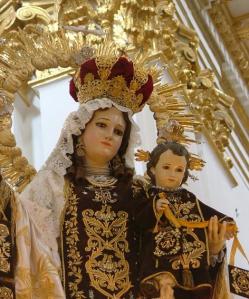
La Virgen del Carmen

La Virgen de Juquila, Oaxaca

La Virgen del Socoro Taxco

The Virgin de La Masacre de Acteal Chiapas


