Wednesday, April 8, 2015

Tianguis

Mikhail Mikhailovich Bakhtin, a russian philosopher said, "Only in the marketplace did the population gather more or less spontaneously without ceremony being imposed from above. The anonymity of the crowd together with the buying and selling that served to put people on an equal footing marked out the marketplace as a domain where the rituals and deference required before lords and clergy did not apply. Privilege was suspended. This atmosphere encouraged forms of discourse excluded from the world of hierarchy and etiquette: parody, ridicule, blasphemy, the grotesque, scatology, revelry, and so on."                
     Socrates frequented the marketplace in Athens.  Why was he so attracted to this cacphonous commercial place? Socrates ambled about like an impish curious vagabond using the language, relationships, and transactions of the marketplace to define ideas more precisely. He cobbled new, even essential meanings, from accepted norms. For example, the definition of wisdom according to him is knowing,,, that you know nothing. Wisdom is derived from a humble attitude. WOW. If one combines humility with curiosity the world is your oyster,,, and I think it saves any visits to the psychiatrist.
     Why though did he value the lowly market instead of loftier aeries where the elite educated classes dwelled? Perhaps because the values and habits of our friends tend to overlap with our own. Those outside of our personal neighborhood, by contrast, run in different circles and thus have different information to offer. By associating with and interrogating anyone who was passing Socrates ran into citizen or alien, elite or craftsman of any trade. The mix afforded him a fresher view. In order to find treasure one needs to leave the security of the house once and a while.
     Another thought about association with friends that tends to close our eyes. Isn't this a reason to be suspicious of school? 
     The great market at Tlateloco:
     According to Motolinia, a Franciscan monk, in 1524, who arrived with the first missionaries in New Spain was astonished at the market in Tlatelolco, a sister city to Tenochitlan. The monk claimed the the distance between opposing corners of the marketplace was the length of a crossbow shot. The exact size of the marketplace of Tlatelolco is not known. According to Cortés, it was twice as large as the plaza of Salamanca.

    Cortés also mentioned, an exhaustive array of products were sold at the market: "feathers, red hot chili peppers, gourds, lime, rabbit hair, slaves, sex, dogs, syrup, rubber, sandals, glue, brooms, needles, mats, “smoking tubes,”obsidian, dyes, etc. The vendors arranged themselves in rows, and each kindof merchandise was restricted to its own particular row: commodities “were not spread out in confusion.”

     Tianguis Tenancingo:

    Sadly most modern culture prefers the supermarket to the crowded caos and noise of the marketplace, yet to feel the antique pulse of Tenancingo with its robust commercial heart one must visit the market (tianguis or street market), an great extension of the large and plentiful daily market. The tianguis is held on thursday and sunday.  It is a precolumbian experience. People gather from all around our city to take advantage of what is available on a grand scale. It is not as organized as the grid like streets of Tlateloco and at times one feels a little lost, the familiarity of the streets one walks during the week having been erased, replaced by a network of vendors. 

     It is important to mention the abundance that is available by name. There is every sort of vegetable, especially onions, leeks, garlic, epasote, parsely, cilantro, common cress and watercress, sorrel, chilacayotes, sugar cane, chayotes, squash, avocados, tomatoes, husk tomatoes, beans, chiles dried and fresh, moles, and artichokes. And there are many sorts of fruit, among which are mangoes, papayas, apples, oranges, strawberries, peaches, cherries and plums. They sell honey, wax, and sweets.They sell much earthenware, which for the most part is very good; there are both large and small pitchers, jugs, pots, tiles and many other sorts of vessels, of good clay and most of them glazed and painted. They sell maize both as grain and tortillas,, and chicken, pork, beef,fish, hen and goose eggs. One can find saddles, machetes, knives, and rebozos. All this and much more.


  Mijaíl Mijáilovich Bajtín, filósofo ruso, dijo: "Sólo en un mercado la población se reune, más o menos espontáneamente, sin ningún tipo de ceremonia impuesta desde arriba. El anonimato de la multitud, junto con la compra y venta que sirvió para poner a la gente en pie de igualdad marcó .. el mercado como un dominio en el que no se aplicaban los rituales y deferencia necesarias antes de señores y clérigos Privilege fue suspendido Esta atmósfera animó formas de discurso excluidos del mundo de la jerarquía y de la etiqueta: parodia, la ridiculización, la blasfemia, lo grotesco, la escatología, jolgorio, y así sucesivamente. "
     Sócrates frecuentó el mercado en Atenas. ¿Por qué estaba tan atraído a este lugar comercial cacofónico? Sócrates deambulaba como un vagabundo traviesa con curiosidad utilizando el lenguaje, las relaciones y transacciones del mercado para definir las ideas con mayor precisión. Él hizo nuevo, significados esenciales, de las normas aceptadas. Por ejemplo, la definición de la sabiduría, según él, es saber ,,, que no sabes nada. La sabiduría se deriva de una actitud humilde.  
      GUAUU. ¿Por qué se valuo el mercado humilde en lugar de aeries más elevadas, donde la élite clases educadas habitaban? Tal vez porque los valores y hábitos de nuestros amigos tienden a solaparse con los nuestros. Los que están fuera de nuestro vecindario personal, por el contrario, correr en círculos diferentes y por lo tanto tienen información diferente que ofrecer. Mediante la asociación con e interrogando a todo el que pasaba Sócrates topó ciudadano o extranjero, de élite o artesano de cualquier comercio. La mezcla le proporcionaba una visión más fresca. Con el fin de encontrar un tesoro que uno tiene que dejar la seguridad de la casa de vez en cuando.
     Mercado Tlateloco:
     Según Motolinía, un monje franciscano, en 1524, que llegó con los primeros misioneros a la Nueva España quedó sorprendido con el mercado de Tlatelolco, ciudad hermana de Tenochitlan. El monje reclamó el que la distancia entre los rincones del mercado oposición fue la longitud de un tiro de ballesta. El tamaño exacto del mercado de Tlatelolco no se conoce. Según Cortés, que era dos veces mayor que la plaza de Salamanca.
    Cortés también mencionó, respecto a la inmensa de productos vendidos en el mercado: "plumas, chiles, calabazas, cal, pelo de conejo, esclavos sexuales, perros, jarabe, goma, sandalias, pegamento, escobas, agujas, esteras, "tubos de fumar", obsidiana, colorantes, etc. Los vendedores se disponían en filas, y cada mercancía se limitaba a su propia fila en particular:  Los productos no se extendían en la confusión"   
     Mercado Tenancingo:
     Tristemente la cultura más moderna prefiere el supermercado en lugar del caos de hacinamiento y cacofonia del mercado, aún sientir el pulso antiguo de Tenancingo con su robusta corazón comercial hay que visitar el mercado (tianguis o mercado de la calle), una gran extensión de la gran y abundante mercado diario. El tianguis se celebra el Jueves y Domingo. Es una experiencia precolombiano. La gente se reúne de todo nuestra ciudad para tomar ventaja de lo que está disponible en una gran escala. No es tan organizada como la rejilla calles de Tlatelolco ya veces uno se siente un poco perdido, como si toda la familiaridad se borró, sustituido por un caos de vendedores. Es necesario nombrar la abundancia. Hay todo tipo de verduras, especialmente las cebollas, puerros, ajos, epasote, perejil, cilantro, berro común y berros, acedera, chilacayotes, caña de azúcar, chayotes, calabazas, aguacates, jitomates, tomates, frijoles, chiles verdes y secos, los moles y las alcachofas. Y hay muchas clases de frutas, entre los que se mangos, papayas, manzanas, naranjas, fresas, duraznos, cerezas y ciruelas. Venden miel, cera y sweets. Se venden mucho barro, que en su mayor parte es muy buena; hay jarras grandes y pequeños, jarros, ollas, tejas y muchos otros tipos de buque, de buena arcilla y la mayoría de ellas acristalada y pintada. Ellos venden maíz tanto como grano y tortillas, y carnes frescas pollo, cerdo, carne de res y pescado. Venden gallina y los huevos de gallina y los huevos de todas las otras aves que he mencionado, en gran número. Uno puede encontrar sillas de montar, machetes, cuchillos y rebozos. Todo esta y mucho mas.

Monday, April 6, 2015

The Snake

Saturday I sat in the office much of the day cultivating ass pimples. Around noon I heard a commotion, an out of the ordinary cry that calls one from their normal stupor. I got up and went outside to find LuLu and Hugo looking towards the side of the office towards the corner where we keep the garbage cans. Richard, the young student who was helping us during easter week was farther away from what ever was startling the others. He seemed in distress. "A snake, a snake",  they said. "Richard encountered a snake!" 
     Hugo and myself entered the space to find a grey snake about a meter and a half long mingling with the brooms.  Richard, who eats only powdered protein in order to appear more macho, ran for safety of the upstairs balcony. Hugo and I each grabbed a broom and ushered the snake towards the parking lot. The gray snake was very agressive biting at the brooms and writhing incessantly. It looked like a black mambo only smaller but I knew it just couldn't have been  venenous,, besides black mambos are from Africa. 
     I pinned the snake as best I could with the broom bristles and Hugo picked it up by the tail. It swirled back and forth like a scared acrobat as it hung from Hugo's hand. Hugo and I proceeded to go out back. With the broom handle I gently kept the snake's head a distance from Hugo's body. As we passed the half closed window of our bedroom, my wife who was inside doing her whatevers heard the snakemeisters passing. A herpetological wind had preceded us set in motion by the maids. Snake news travels like a brush fire here. My wife's voice emanated from the room in a screaming run on sentence. "Don't bring that thing in here, where are you going with that vibora, kill that frigging snake, Hugo come here,, no don't come here, what are you doing? Just kill it!  You see Mexicans aren't very conscientious environmentalists. Once when I switched three incandescent bulbs in the house of 50 watts each for three LEDs totaling 16 watts my wife's face contorted and she urged me to return everthing to its previous state because she thought the LED color was destroying the ambience of la casa. Mexicans kill everthing that moves except butterflies and snakes are top of the mexican hit list. It is a wonder to me that there is still a rich natural complex even if much of it is threatened.
     This time, however, I wasn't going to kill this snake. An incident a few years ago had made me adamant. A maid had exited the kitchen to find a 6 foot boa lounging on the house porch. At the time of her discovery I was riding back to the hotel on my bike and when I received the news delivered in screeching panic via cell phone from my wife I didn't know if it was a ten foot rattler threatening clients. "Snake" to most Mexicans can mean anything that crawls. Arriving at the hotel I went out back to the house where there were three maids armed with brooms screaming that they would never return to work if I did not kill this snake. At that moment they looked like a tribe of Ubangis confronting the ghost of an ancestor. I tried to explain about boas but no one would listen. They just accused me of being less than a man for not jumping onto the animal and strangling it to death. 
     I cut a forked stick and tried to pin the head of the snake, but it was still on the tile floor, not on soft earth where the stick could have penetrated the soil and held fast the serpent. It slithered away and into a hole beneath the pavillion. "Well", I said,"It's gone." These were the key words unlocking all the accumulated snake hate and misinformation from the year 3,000,000 BC to the present. They ganged up on me and urged me to do something lest the serpent return, lie in wait, then drop down from a bush coiling about one of their necks choking them slowly their eyes bulging from their almond heads.
     I got the hose and inserted it in the hole beneath the pavillion allowing the orafice to fill and overflow for 20 minutes yet the boa never appeared. I pictured it trapped in its muddy tube now deformed by water holding its breath until it could no more and expiring. I covered the hole with a cairn of rocks to please everyone. I swore, however, this wasn't going to happen again even if it was a rattler. 
     Hugo and I let the gray snake go in the tall grass in back of the hotel where there is lots of field and few dwellings. It quickly slithered away  into the dry grass and disappeared. I wished it luck, thenI rushed to the computer to identify the snake,, or really this incident couldn't count as a learning experience. After 20 minutes of searching I found what I think it was,, a racer. The agressiveness, movement, size, and color seemed to fit.          


True Inundations y medio mentiras

We have mosquitoes that carry dengue fever now. We hung a tarp in front of the hotel at the behest of the town to warn everyone of the dangers of dengue. On the tarp there is a picture of a huge mosquito swollen with blood. I think it does to the hotel business what a scatological conversation does to a dinner out.
     One night last august the rivers overflowed their banks during a particularly heavy rain  and flooded an the entire colonia San Mateo. There were bodies hanging from the trees like ugly ornaments.
      I was driving to town on the new turnpike after the rain and I passed the military base. Where their little sewage treatment plant sits by the side of the turnpike there was a river of pure drainage transversing the highway.  My window was open and a taxi coming in the other direction hit the water which sprayed into the cab of my truck. Of course I had a mouthful of soldier's turds. I am sure I will come down with cholera and typhoid in a few days. 
     I paid some narcos to kidnap my wife but they kidnapped me instead. She wouldn't pay the ransom of $1767.56 pesos so I traded my pickup for my freedom. Now I am without wheels. 
     I sleep on a cheap cot since I was kicked out of the house and now I have chronic back pain. I cannot pay for treatment because I am so broke that I can't even pay attention. 
     I have nothing to say and I am saying it. 
     A Little Joke: A Chicken and an egg are lying in bed. The chicken is smoking a cigarette with a satisfied smile on its face and the egg is frowning and looking put out. The egg mutters to no one in particular, "I guess we answered that question." 

Sunday, April 5, 2015

Chalma

     We walked to Chalma beginning wednesday night or early thursday morning during holy week. I have often written about Chalma, a holy place, the site of pilgrammages since way before Chris landed in Hispañola. From Tenancingo it's twenty three kilometers, up through a mountain pass, and down a steep rocky path to Malinalco, then along the highway until one reaches Chalma.The week prior to the walk I had my preoccupations about the trip. My
bones are getting tired of suporting 200 pounds of unhealthy fat yet with a new pair of sneakers, I felt confident. You know those with thick magical bouncy soles that make a white man feel he could take off flying from the key putting away two with gusto. What a false sense of power,, but none the less thick soles do help. 
     Here is a link to a pilgrimage to Chalma from Milpa Alta Parts One and Two: https://youtu.be/jYsoAmPZBKo          https://youtu.be/q9145nM02ms
     People pass the hotel all that particular night night on the way to Chalma,
perhaps 30,000.  We began our journey about 2:00 AM, following bunches of people on the same path, like clumps of scree floating at different speeds on a briskly moving stream. Beautiful night bathed in the blue light of a moon just about full. I am not exactly sure how the high priests calculate easter but it seems to always fall when the moon is near complete. I suppose that is why the date for easter is different each year.
     For those who do not know of Chalma here is a link:
http://www.mexconnect.com/articles/976-the-magic-of-chalma

     The motivation for a pilgramage is piety. The manner is to distance oneself from their comfort and quotidien through physical exertion. The physical act empties the body and the soul rendering it more sincere and of course more open to suggestion. It works. There is a spiritual commraderie that pervades these walks,, one purpose, one mind, a blissful destination.
      The moon was fragmented by the trees in the mountain pass and later when we had almost reached Malinalco it bathed the stone path in its scintillating light. By the time we reached the highway the pace was like a repetitive chant, and the nocturnal ramble's magic began to take control of our compass. The last three kilometers are punishing,, a prolonged upgrade.Then there is Chalma in the distance a clump of lights in the nearing dawn. It is a dirty little town scarred by lower class use,, of sacred waters, set between camel backed parched mountains. The church is imbedded in the very center of Chalma, like a zircon. It is one of the best maintained churches in the area. Like latter day zombies we approached the edifice accompanied by many adorned with flowery crowns. People with crosses and others with statues are all about us looking to be blesseed with holy water. I fell to my knees in front of the altar,, emptied of my prejudices then exited to the left behind the altar where I was slowly extracted from a dream. We filed along sprayed with holy water flung by a priest onto the crowd. I stopped in an alcove and stood transfixed, reading some script written on one of many large ominous paintings from the 16th century. The phrases labeled the indigenous people as savages. At that moment I became conscious of my aching legs.
Then just before the exit behind the church where the river meets the Augustinian architecture we passed the "cajeros" a gauntlet of little windows like bank tellers ready to accept your donation. I couldn't allow this side of religion to steal the moment from me. I wondered if ancient precolumbian priests managed the same set up. Probably,, then I thought,, but what has that got to do with my personal experience. We crossed a bridge over the river and entered a small building housing "retablos" which are painted prayers, solicitations for loved ones. Others are thanks to the "Señor" for prayers that have been answered. A common practice in many churches since the 19th century these retablos were painted by roving folk artists on metal plates. This small building filled with devotion helped ease the contradiction.


Thursday, April 2, 2015

Who Is Religious and Religious Capitalism?

     Easter week is the most religious time in Mexico. Tenancingo is no different than other towns of its size who all celebrate the "Coming",, then "Going", then "Coming" again. Tenancingo has many events that pay homage to this holiest of weeks. Palm Sunday, Pilgrimages to Chalma, Procesion del Silencio, the walks up to the statue of Cristo Rey, the crucifixtion story replayed in Quetzapalapa, 
(  https://youtu.be/8SCOiUs8LM4   ), , and so much more.
     Mexico, for the most part agrees with me. Let me say though that I may just be a living contradiction. I feel comfortable with the viscous catholic atmosphere in Mexico,, yet I don't give in to it. Mexican catholicism isn't, at least at this point in its long history, virulent. I know there are many that would take umbrage with that statement. Perhaps they are idealists,, and perhaps they are reformers. A quote from Thomas Carlyle:
To reform a world, to reform a nation, no wise man will undertake; and all but foolish men know, that the only solid, though a far slower reformation, is what each begins and perfects on himself.
Much of the mexican population is relieved of so much of the burden of this life by immersing itself in religious myth. I avoid swimming now,, but I find solace in ceremony and the cool lofty spaces of old churches.
     This holy week I have been thinking about a statement that a friend made, who lives in Sweden,, that Sweden is the least religious country in the world.  This is a poll determined fact. Polls always need clarification. My knee jerk reaction at the time was that the US was really the least religious place on earth. From Bob Dylan's It's Alright Mom:

Disillusioned words like bullets bark
As human gods aim for their mark
Make everything from toy guns that spark
To flesh-colored Christs that glow in the dark
It’s easy to see without looking too far
That not much is really sacred


     Then I thought well possibly prejudice was ruling my thoughts. Usually it does. More questions followed. What do I mean by religious?  What is relgion anyway but a human invention like roquefort cheese that seems to taste better with age and even better when the brand has achieved world class status. Then like a dusty wind I thought of all those calvanists, methodists, congregationalists, baptists, anal baptists, catholics, evangelicals, mormons, botulists, ana capitalists, and neo marxists etc. and the myriad religious currents that determine the direction of the US media,, and let's not forget all those churches of stone, but mostly of wood, from Fort Kent, Maine to Bumblefuck, Missouri. It seemed an impenetrable wailing wall of faith. If ordinary people in the US, like, let's say,  Ernie "Bip" Parlene in Shitwater, Alabama were polled about what role religion plays in their life a majority would say "of course,, as God is my witness, He is always by my side,,,, also  in my house, on the dashboard of my car, encrusted in my soul, like a stalactite, for he fills,, at least some of my Sundays with joy,, and on and on they drone,,, but here the lady doth protest too much methinks. Why do I sense all this religious rap is just a facade?
     Where does religion come from anyway? Many know the story. It is natural for humans to group up like drops of oil on water. The first nuclear family, Adan and Eva, ( they were latin of course) grew into a greater clan made up of belly button relations and as time went by that clan turned into a tribe based on broader parameters. Agriculture was invented in the year 9263 BC by Kyle Otsi. Master-slave social relations were formed. Some tribal members with low foreheads were designated to go into the field with a hoe and others, who were clever enough to avoid the shovel, stayed in the lodge to "do the books" so to speak. These bookkeepers had great ambition and a lot of time on their hands, much more  than the average schmo. The bookeepers created and then presided over ceremonies that coincided with celestial events. These ceremonies morphed into modes of popular adulation after some bookkeeper's wife in Ninevah, named Griselda La Panza, made him a colorful feathery robe and she mandated that her cousin Raul to carve the bookeeper an elaborate staff. Armed with a robe and a staff the bookkeeper cruised the dusty streets, yet now puffed up with regal pride. People noticed him and looked up from their toil at his impressive sartorial contenance and they listened to what he said, now more than ever. His phrases changed and became seasoned with celestial musings that confused them. After a week he began to call himself Ahitub the First, son of Zadouk the Lesser.
     One night indigestion brought on from eating 3 and a half measures of bee larvae caused him to have a strange dream in which his aunt Hulda The Clever, who they had just buried three days ago, was conversing with him as if she were still alive. Ahitub awoke in a state of wonder and during his morning ablutions he invented the completely new concept of two separate worlds, one with material things like rocks and mud and the other ethereal, without substance. At that very moment he began to market the after life, of course without ever crediting Griselda.
     Bookeepers evolved and separated into two distinct groups, one group acted like rulers and other like priests. One group controled the army and the other the keys to the afterlife. Meanwhile tribal hiearchies gave way to larger fiefdoms then finally countries with boundries to be defended.  The bookkeepers multiplied causing inter-fiefdom strife and persistent wars.
     What is religion but a concept born of indigestion and fantasy? How can any particular group be deemed to be more religious than another given the foundation of religion, an imaginative concept that embellished a natural tendency in humans,, that is to form groups. Wow, I thought, I am on to something. Religion is only part of a fanciful human sandwich. The lettuce perhaps? 
     Humans have re-invented faith over and over but always in a horizontal direction resulting in a similarity in the content and purpose of all religions. Look at the history from Baal to The Islamic State. This discovery, however,  did not address my reaction to the question about Sweden being the least religious country on earth. If religion is based on the interpretation of a dream by a clever clan member, Ahitub the First, then Ernie "Bip" Parlene in Shitwater, Alabama is just an unwitting inheritor who posseses some undefined faith handed down through the ages, born of the first formal proclamation by Ahitub which went something like this: "By the grace given me by the Akkad, Amarru, and Elam, I have been shown the true path,,,,, blessed are all those that believe,, and may the rest receive eternal damnation."
       Ernie's example isn't the reason I contend that the US is underneath it all an irreligious lot. It's the burgeoning godless middle and upper classes that value "rocks, trees, and me-phones" over anything spiritual. To complicate matters I find the lower classes in Mexico to be truly devout. They exist in a world that is heavily skewed towards the spiritual, and  practice rituals each day that the lower classes in the US would deem foolish. Witches are very popular and taken seriously in Mexico and palmists still flourish. 
     I thought,,then, perhaps this isn't fair. The lower classes in the US express overtly their faith rolling on the floor, speaking in tongues, or praying devoutly with rattlesnakes in hand. There seemed to be similarities with their mexican counterparts. The modern middleclasses, however use religion more to affirm their economic station than to embrace their spiritual side. They are turned off by witches and rattlesnakes as low sport for the scientifically uneducated. What really excites the middleclasses, is not a stirring sermon by Reverend Wrigglesworth about Jonah and the whale but new car smell and saturday bar-b-cues.           
     Capitalism, however, seems to contradict religious devotion. It seems to demote piety for God to cheapened disloyalty. This theory, however, made me uncomfortable. Perhaps it is my own catholic past that is speaking here. Max Weber, a father of sociology, wrote in The Protestant Ethic and the Spirit of Capitalism that the protestants, especially calvanists, were disposed to become capitalists. This seemed to contradict my thoughts about religion and capitalism. Protestants, Weber claimed,  possessed a strong work ethic. They devoted themselves to secular professions, acted soberly, and saved their pennies. Calvanists, though, went a step further. They believed that religious salvation was predestined, and consequently they found that profit and material sucess were rewards from God, like benedictions. Hey I must be on the right road to heaven because my pockets jingle. Calvanists already had the protestant methodology in place to build economic success. They just made a short leap from God to capitalism and the rest is history,,, and they still went to church. 
     Sobriety, hard work, and asceticism combined well with the early development of capitalism. What is different about post WWII capitalist United States is the shedding of the protestant basic manual and using rampant consumerism to satisfy new exotic hungers,, the "gimme two yesterday" mentality that pervades the present day economic powerhouse. It's enough to make a Calvanist vomit. Consumerism is at odds with the ethic that got them there in the first place. Yes, I think the US is most irreligious to the calvanist capitalistic cannon. Consumerism places a great portion of the population in a category indifferent to sobriety and asceticism. Sweden is a small country, only 9 million or so and is certainly not a society of consumers on par with the US. They might claim religion is unimportant to their well being. Swedes may only want to achieve Lagom, read Strindberg, or fall in love, but this may only indicate they have fostered more cultural cohesion than people from the US. Methinks the American Woman doth mouth off too much about their faith. By degrees I'd bet that down deep Swedes are more religious.
     It seemed that Max Weber's Protestant Ethic And The Spirit Of Capitalism could be applied to catholic and muslim countries as well. Catholicism, it seemed, had impeded Italy and Ireland,, at least for a while. Look at how Latin America and the muslim world has lagged behind economically in comparison to the west. Catholics, at least european and US catholics have a tradition of hovering between Adam Smith and Karl Marx. Calvanists may understand and be comfortable with the need for inequality between the classes as necessary to promote individual economic creativity. "If you don't work you don't eat." A sloth can never gain heaven." European and US Catholics have paid lip service at the very least to wanting to eliminate that earthly inequality,, yet in the last century european and US catholics by and large have participated with vigor in the capitalistic empire. Islam, however, has not. Islam has a long history at odds with the capitalistic principles of banking and corporations. The Protestant Ethic And The Spirit Of Capitalism,  however, does not explain everything. What of poor catholic Latin America?  What of economically successful medeval Islam?  Where do they fit into the protestant schematic? The severe role colonialsm has played in the underdevelopment of these spheres cannot be ignored.In Latin America there is plenty of economic movement but the model for that movement is not Calvin but the cacique or the politician,, if there is a difference. Islam since medeval times has been hobbled by colonialism and a retreat deeper into itself,, a vicious cycle.
      As for religion, I believe any image of God is corrupted by human incapabilities. Who can even wrap their mind around the Big Bang or a the concept of billion light years distance,, let alone OUR frail concept of what God might be? I am however drawn to certain expressions of faith perhaps more since those expressions are closer to my own catholic upbringing. In Mexico the faith of the poor,, and there is no shortage of poor here, is personal and stirs my soul. It is used in an attempt to touch the untouchable. In the US expressions of faith rile me. Perhaps in the US faith and tradition are used for other means.


Tuesday, March 31, 2015

Peregrinacion de la Virgen de Guadalupe The March of the Humble


In February we accompanied the annual pilgrammage from Tenancingo to the Basilica de la Virgen de Guadalupe in Mexico City.  (If you don't know about the Virgin Of Guadalupe click or paste this link)
http://www.huffingtonpost.com/2013/12/12/virgen-de-guadalupe_n_4434582.html  
     We walked with the pilgrammage for the first 10 kilometers of their 100 kilometer walk which takes 4 days to complete. The first 10 kilometers, on a dirt road, are all uphill ending in a small town called Zepayautla. Tenancingo is 2020 meters above sea level and Zepayautla (means place where it snows) is another 400 above that.
     There must have been at least 5000 people on this march. It's difficult to say exactly how many because we joined the group in Tenancingo where it is flatter positioning ourselves at the front with our parish so there was no way to see the entire length of the line until we reached San Martin. The dirt road wound its way up from Chalchihuapan following the creases in the mountainside switching back on itself in long arcs. In San Martin when we reached the top of an exceptionally long curve I had the opportunity to catch a glimpse of part of the line, below, through an open field. I could see people passing below at least a kilometer behind our parish. 
     The pilgrammage is broken into groups representing each pueblo that participates. Tenancingo, Villa Guerrero, Coatepec, Porfirio Diaz, and Sultepec were some of the towns that participated. I belonged to the Parroquioa de la Trinidad, somewhere near the front. Each group has their own "callers" who animate their sector. They begin a song and everyone joins in adding whoops and cheers. I found early in the march that photos alone cannot capture such an event. Sound is necessary to complete the portrait. The singing, chanting, and even bands are one palette of colors. The rockets, a common sound in all mexican festivities, leave the hand of the cohetero with a zipping sound,  then explode loudly reverberating off the mountains.


San Diego


  El Nevado de Toluca


     Mexico is a country of idols and images. This pilgrimmage was no different. People were carrying  heavy images of the Virgin of Guadalupe adorned with flowers and flaglets. Singing and banter was meant to arouse the group. Perhaps the pace needed to quicken. Some would dance a jig. There were songs for Maria, the virgin for all Mexicans,, the distillation of "mother", and to Jesus to lessen the load but also to provoke passion. This route through Chalchihuapan and San Martin is dotted with avocados and nopals. It is not heavily populated, but habitants of the few houses were outside clapping as we passed handing out oranges and water.
     The religious spirit in Mexico is infectuous, at least among the lower classes. There is an exhuberant devotion rooted deep in the mexican psyche, a vivacious belief, both incorporeal and earthy. I suppose being raised catholic leaves me open to part of it, for the religion into which we were born is sutured to our tails. 
     When we arrived on the fringe of Zepayautla near 1:00 PM the church bells began to sound with bravado. The whole town was out to greet the pilgrims forming a corridor or on their balconies waving from their windows. In the plaza in front of the church the Zepayuatlans were handing out free food. People continued to pour into the plaza like a breach of holy water. We grabbed a plate of chicharron  en salsa verde and moved to the side. Zepayautla was where we would leave the rejoicing. Most would still continue for three more days. I felt an existential tinge that I should put my emotions in the cooler but it wasn't  possible to fight being overwhelmed by the burgeoning spirit. 


 Un par de semanas atrás, nos acompañó a la peregrinación anual de Tenancingo a la Basílica de la Virgen de Guadalupe a la Ciudad de México. Es una marcha de los humildes a su santuario más sagrado.
Nos quedamos con la peregrinación por los primeros 10 kilómetros de su 100 kilometros a pie, que tomarían 4 días. Los primeros 10 kilómetros sobre un camino de tierra, son todos final cuesta arriba en un pequeño pueblo llamado Zepayautla. Tenancingo es 2.020 metros sobre el nivel del mar y Zepayautla (significa lugar donde nieva) es otro 700 por encima de eso.

 Debe haber habido al menos 5.000 personas en esta marcha. Es difícil decir exactamente cuántos, pero cuando llegamos a San Martín había un pequeño claro, y yo era capaz de ver más adelante a través de una abertura en una línea de árboles que la gente en la peregrinación pasaban al menos un kilómetro por debajo de nosotros.
La peregrinación se divide en grupos que representan a diferentes pueblos. Tenancingo, Villa Guerrero, Coatepec, Ixtapan de la Sal, Porfirio Díaz, y Sultepec eran pueblos que participaron. Yo pertenecía a la Parroquias de la Trinidad, en algún lugar cerca del frente. Cada grupo tiene sus propios "animadores" que dan vida a su séquito con canciones y cantos. Comienzan una canción y todo el mundo se une en la adición de gritos y alabanzas. Dos pueblos trajeron sus propias bandas añadiendo Música Norteña a la mezcla ecléctica.

Me di cuenta al principio del paseo, ya que yo estaba tomando fotos que la fotografía por sí sola no era suficiente para capturar el espíritu. El sonido es necesaria para completar el retrato. La cantos, canciones, bandas, y la charla son una paleta de colores. Los cohetes, una ocurrencia común en todas las festividades Mexicon, dejan las manos del cohetero hacer ruido comprimir seguido de un breve silencio cuando el cohete se suspende en un cielo azul, seguido por una fuerte explosión. Las montañas que nos rodean juegan a la pelota con el eco.La idolatría es frecuente en México. Eso no es tan inusual. Los ídolos son una forma táctil de la divinidad. Al ver la ayuda hace creer. Muchas de las divinidades precolombinas han sido reemplazados por imágenes católicas. Para los mexicanos que son más que símbolos de la fe. Son las divinidades encarnan. He visto a personas, jóvenes y viejos, tocando imágenes y estatuas con gran pasión, entonces acariciándose con el fin de transferir el poder. Hay dioses, santos y vírgenes aquí, suficiente para todos. Nuestra Señora de Guadalupe, sin embargo, es el único y verdadero santa mexicana y madre colectiva eclipsando todos los demás. Ella se teje densamente en la identidad nacional mexicana. En el pilgrammage hay personas que llevan grandes imágenes de la Virgen en marcos gruesos montados en mesas amorosamente adornados con flores. Despiertan entre sí, como un reto, para acelerar el paso, cantar, o bailar, canciones de Maria y en menor medida a Jesús. Pasión domina el dolor. La gente a lo largo de la ruta salen de sus casas aplaudiendo y saludando a los peregrinos. Muchas naranjas y agua repartir. El espíritu religioso en México es Infectuous. Supongo que siendo criado como católico me deja abierto a ella. Me resisto a la parte religiosa, pero me permito el espíritu de humildad para entrar. Después de todo la religión en la que hemos nacido está ligada a nuestras colas.
Cuando llegamos al margen de Zepayautla las campanas de la iglesia comenzaron a sonar constantemente. Todo el pueblo volvió a saludar a los peregrinos. En la plaza del lado de la gente del pueblo la iglesia sirve sándwiches y enchiladas gratis Paramos a comer y descansar un momento, pero los peregrinos seguían llegando a la plaza inferior como el agua de una presa de ruptura. Pronto estábamos hombro con hombro con miles de personas. Un sentido de comunidad está ausente en el día a día la vida de México. Supervivencia determina cómo vivimos en América Latina. Sé que en momentos como este que debo poner mis emociones en el refrigerador, pero no era posible luchar sentirse abrumado por el espíritu positivo colectivo exhibido ese día.


Monday, March 30, 2015

Domingo de los Ramos (Palm Sunday) 

I am not a religious person,, but I do attend some religious ceremonies. I attend these ceremonies in Mexico with admiration for the devout poor who still make them possible and who take them seriously.  As Albert Camus once said, "I do not believe in God but I am not an athiest." That may seem like a dichotomy to some, but I don't see the contradiction. In the futile search for purity one will always encounter contradictions, but the western canon is built on glorious contradictions. It is a dog that perpetually bites its own tail,,, and thank God for that!
The human race seems to be genetically programmed to create religion. A song by the mexican singer songwriter, Jose Alfredo, entitled Vamanos (let's get out of here) begins with the line, "No somos iguales, dicen la gente." (People say no one is equal). Because of that inequality humans have been able to create hierarchies within the framework of socio-political or religious systems. Nietzsche argued that there were two fundamental types of morality 'Master morality' and 'slave morality'. Slave morality values things like kindness, humility and sympathy, while master morality values pride, strength, and nobility. With any group, large or small, a hierarchy will form and masters emerge to manipulate the crowded field of slaves. The church represents itself as both master and pastor to slaves. Historically the morality of its masters has been dubious. Myself, I prefer both the strong willed and the humble. Depends on my mood.
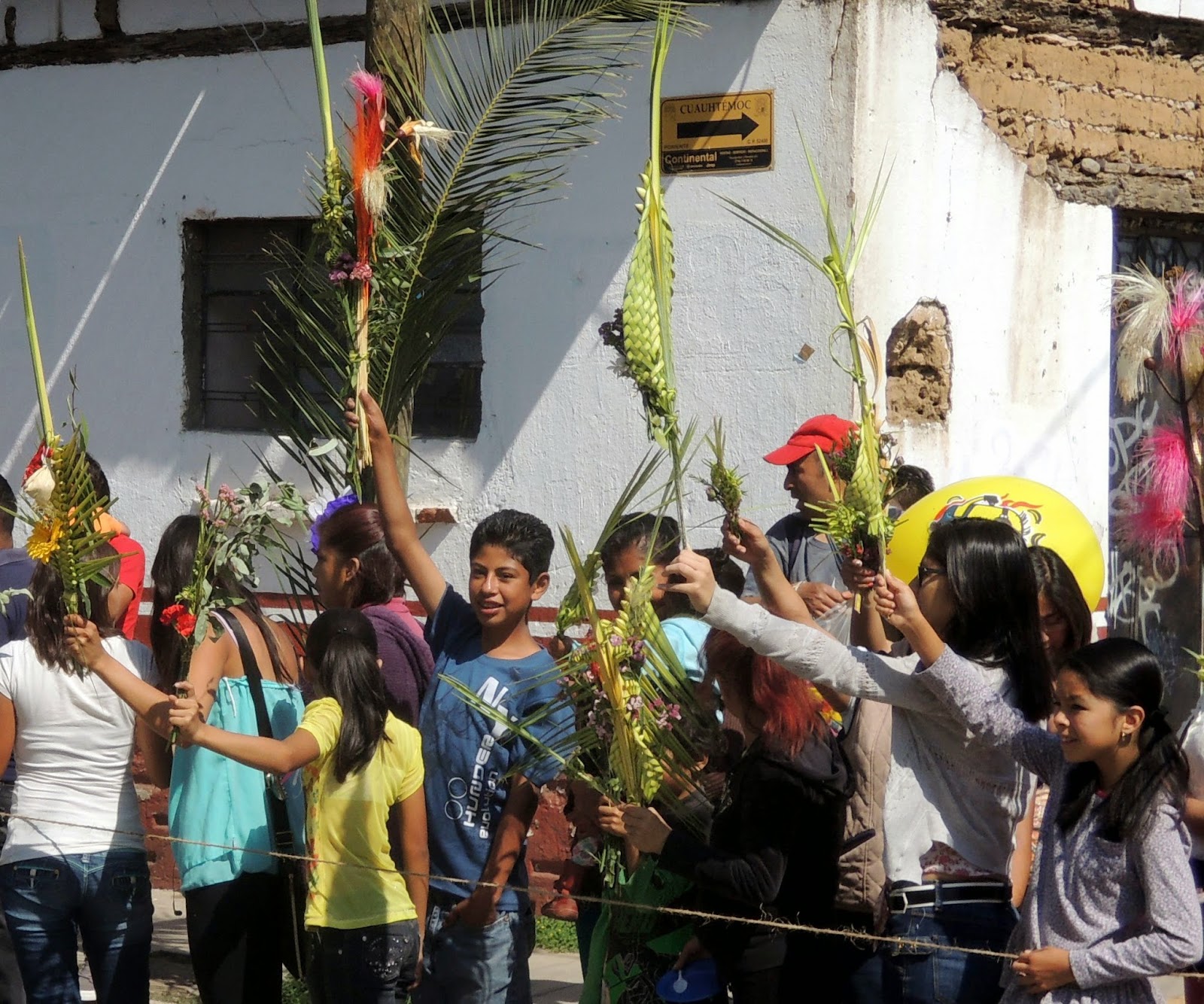
Easter week has begun. Yesterday was Domingo de los Ramos or palm sunday. Palm sunday is an exhuberant colorful festival of welcome in contrast to Good Friday, a solemn event which commemorates the crucifixtion. This particular procession, the largest in Tenancingo starts at a church called El Huerto at about 10:00 AM and proceeds several blocks to another church called San Francisco La Parroquia. When they arrive at San francisco the people pour into the courtyard "palms up" to receive a blessing and hear a mass.

No soy una persona religiosa ,, pero me asistir a algunas ceremonias religiosas. Yo asisto a estas ceremonias en México con admiración por los pobres devoto que todavía hacen posible y que los toman en serio. Pensaba en Como dijo una vez Albert Camus: "Yo no creo en Dios, pero no soy un ateo." Esto puede parecer una dicotomía para algunos, pero no veo la contradicción. En la inútil búsqueda de la pureza que uno siempre se encontrará con contradicciones, pero el canon occidental se basa en contradicciones gloriosos. Es un perro que muerde su propia cola perpetuamente ,,, y gracias a Dios por eso!
La raza humana parece estar programado genéticamente para crear religión. Una canción por el cantante y compositor mexicano, José Alfredo, "Vamanos" titulado comienza con la frase: "No Somos Iguales, Dicen la Gente". (La gente dice que nadie es igual). Debido a que los seres humanos de desigualdad han sido capaces de crear jerarquías en la structura de los sistemas socio-políticos o religiosos. Nietzsche sostenía que había dos tipos fundamentales de la moralidad,  "moralidad maestro" y "moral de esclavos". Moralidad de los esclavos valora cosas como la bondad, la humildad y simpatía, mientras moralidad de los señores valora orgullo, fuerza y ​​nobleza. Con cualquier grupo, en el mundo de ser humano, grande o pequeño, se formará una jerarquía y maestros emerger de manipular el campo lleno de esclavos. La iglesia representa a sí mismo como maestro y pastor de esclavos. Históricamente la moralidad de sus maestros ha sido dudosa. Yo, personalmente, prefiero tanto la fuerza de voluntad y los humildes. Depende de mi estado de ánimo.
Semana Pascua ha comenzado. Ayer fue Domingo de los Ramos o Domingo de Ramos. Domingo de Ramos es un festival colorido exuberante de bienvenida en contraste con el Viernes Santo, un acto solemne que conmemora el crucifixtion. Esta procesión particular, el más grande de Tenancingo comienza en una iglesia llamada El Huerto a las 10:00 am y procede a varias cuadras a otra iglesia llamada San Francisco de La Parroquia. Cuando llegan a San francisco las personas vierten en el patio "rechaza" para recibir una bendición y escuchar una misa.


                                 Women weaving the Palms with flowers, laurel, and copal

                  Woman making eye contact, of course without incurring any obligation.


                                                          Waiting for Jesus

                                              These men carry the heavy statue.


Palms and ribbons adorn the route.


Friday, January 16, 2015

Happiness should be found in the simplest of places. Yesterday I went to town twice to the large sunday market in Tenancingo called a tianguis to buy supplies for the week. The first time I traveled by bike. It is pleasing to combine exercise with purpose. On the return my legs felt leaden as I lackadaisically peddled home. It seemed I had lost my strength and will. Perhaps it was one of those weak moments brought on by too little sleep and too much seasonal fat. The second time I took a taxi and returned by bus. I was sitting on the bus waiting for it to fill up passing the time with my head nestled in my hand like a ripe melon, watching the odd flow of people go by. It's always the same backdrop on this corner. The dark small pasteleria, the newstand, both their awnings baked in grime. The grubby "in and out" brick pattern, one layer in and one out, painted so many times that the edges of the brick were rounded. The lady who sells alegria always knitting and watching, sending her son on each bus just before takeoff with a basket of goods. The people that pass however seem to be different each time. They reek of humanity crowded jilting swaying jiggling. 
I felt meloncholy for some reason. A couple mounted the bus with their little daughter.  By this time there were no seats remaining so they stood. The bus left its crowded dock and began to inch into the current of traffic. For some reason the couple captured my attention. Their clothes were a little ragged. The father's pants worn to a shine were black with gray stripes and his zipper distorted. The mother had on a black sweater unthreading at the cuffs. Her hair was pulled up haphazardly onto tghe top of her head. The parents smiled and talked in a lively manner, and I thought, like heroes in the seaweed. The little girl bore a jacket color rosa mexicana but soiled on the raised creases. She had a smile from ear to ear and a new array of adult teeth filled her up grin. like a string of oversized chiclets.  I thought to myself that this girl is too happy to be normal. Isn't that the way a meloncholy mind works, liberated, and focused. Believe it or not I wondered if she might be a bit retarded. The bus hobbled along and some people exited making room for the family. The father sat over there and the mother over here,, then Mom called the girl,,, ven mi amor (come my love) and she bounced over and sat on mom's lap. At once the girl began to talk softly to herself or perhaps someone else completely immersed in her own fantasy. My spirit lifted and meloncholy fell away like a snake's old skin.